Tuesday, February 13, 2007

Pineridge Vaskur of Greenstone Kennels out Camping in Nunavut, Canada

Hello Folks, Thought you might like to see Vaskur out at one of the camp site out on the tundra in the high artic of Canada, this was a flyin, and then boat in camp. Vaskur had lots of fun, hiking up to 15 kms plus a day, keeping those pesky Boo away from the camp and his group of humans, and had lots of fun cooling off in the many lakes and creeks.. Its on hikes like these that you truly get to see the Double dewclaws at work.. Most folks this the dewclaws are for climbing up, but I have found in the artic tundra landscape, its much more about gaining more control on the climb down. They just spread them out and use them as extra toes. I have found that my dogs love to go anywhere and will try anything as long as they get to be with their owners.

Barks

isdpuppies@hotmail.com

If you are interested in getting a greenstone Puppy, please contact me, I considering two litters this year, please get on the waiting list early if you are hoping to bring a Greenstone Puppy into your home this year.

Sunday, February 11, 2007

Canadian Iceland Sheepdog Standard


Iceland Sheepdog


Origin & Purpose
The Icelandic Sheepdog is Iceland's only native dog. It was brought to Iceland with the first Viking settlers (AD 874 - 930). The Icelandic Sheepdog and its method of working adapted to the local terrain, farming methods and the hard struggle for survival of the Icelandic people over the centuries, making it indispensable in the rounding up of livestock on the farms. The Icelandic sheepdog's popularity has increased over the last few decades and, despite the fact the breed is still very small in numbers, it is no longer considered to be in danger of extinction.

General Appearance
The Icelandic Sheepdog is a Nordic herding Spitz, slightly under medium sized with prick ears and a curled tail. Seen from the side the dog is rectangular; the length of the body from the point of shoulder to point of buttock is greater than the height at withers. The depth of the chest is equal to the length of the foreleg. The expression is gentle, intelligent and happy. A confident and lively bearing is typical for this dog. There are two types of coat, long and short both thick and extremely weatherproof. There is a marked difference in appearance between the sexes.

Temperament
The Icelandic Sheepdog is a hardy and agile herding dog which barks, making it extremely useful for herding or driving livestock in the pastures, in the mountains or finding lost sheep. The Icelandic Sheepdog is by nature very alert and will always give visitors an enthusiastic welcome without being aggressive. Hunting instincts are not strong. T he Icelandic Sheepdog is cheerful, friendly, inquisitive, playful and unafraid.

Size
Ideal height is:
Dogs: 46 cm. and Bitches: 42 cm.

Coat & Colour
Coat: Double coat, thick and extremely weatherproof.

There are two variants

Short haired
The outer coat of medium length, fairly coarse, with a thick, soft undercoat. The hair is shorter on the face, top of head, ears and front of legs, longer on the neck, chest and back of thighs. The tail is bushy and the hair length is in proportion to the coat.

Longer-haired
The outer coat is longer than the above, fairly coarse, with a thick, soft undercoat. The hair is shorter on the face, top of head, ears and front of legs, longer behind the ears, on the neck, chest, behind the forelegs and back of thighs. The tail is very bushy and the hair length is in proportion to the coat.

Colour: Several colours are permitted but a single colour should always be predominant. The predominant colours are:
· Various shades of tan, ranging from cream to reddish brown.
· Chocolate brown.
· Grey.
· Black.

White always accompanies the predominant colour. The most common white markings, which are often irregular, are a blaze or a part of the face, collar, chest, socks of varying length and tip of tail. Lighter shading often occurs on the underside of the dog from throat to tip of tail. On tan and grey dogs a black mask, black tips to the outer hairs and even occasional black hairs often occur. Black (tricolour) dogs have a black coat, white markings as mentioned above and traditional markings in any of the various tan colours on the cheeks, over the eyes (eyebrows) and on the legs. Patches of the above colours on a white background (pied) are permitted. White should not be totally predominant.

Head
Strongly built with close fitting skin. Skull slightly longer than muzzle. Triangular when seen from above or the side. Skull: somewhat domed. Stop: clearly defined though neither steep nor high. Nose: black, dark brown in chocolate brown and some cream dogs. Muzzle: well-developed, nasal bridge straight. Muzzle slightly shorter than skull. Tapering evenly towards the nose to form a blunt triangle when seen from both above and from the side. Lips: black, close fitting, dark brown in chocolate brown and some cream dogs. Cheeks: Flat. Bite: scissor bite. Complete dentition. Eyes: of medium size and almond shaped. Dark brown. Slightly lighter in chocolate brown and some cream dogs. The eye-rims are black. Dark brown in chocolate brown and some cream dogs. Ears: erect and of medium size. Triangular with firm edges and slightly rounded tips. Very mobile, reacting sensitively to sounds and showing the dog's mood.

Neck
Moderately long and muscular with no loose skin. Slightly arched and carried high.

Forequarters
When seen from the front the forelegs are straight, parallel and strong. Normal angulation. Shoulders: oblique and muscular. Dewclaws: may be double. Forefeet: slightly oval toes well-arched and tight with well-developed pads.

Body
Rectangular and strong. The length in correct proportion to height and in harmony with general appearance. Level, muscular and strong. Loins: broad and muscular. Croup: moderately short and wide, slightly sloping and well muscled. Chest: long, deep and well sprung. Belly: only a slight tuck up.

Hindquarters
When seen from behind the hindlegs are straight, parallel and strong. Normal angulation. Thighs: broad and well muscled. Dewclaws: well-developed double dewclaws are desirable. Hindfeet: same as forefeet.

Tail
High set, curled over and touching the back.

Gait
Displays agility and endurance with good driving action covering the ground effortlessly.

Faults
Any departure from the foregoing points should be considered a fault and the seriousness with which the fault should be regarded should be in exact proportion to its degree.

A solid black mantle or saddle on any of the various tan coloured dogs.
Serious Faults
Lack of dewclaws.
Yellow eyes.
Round protruding eyes.

Note:Male animals should have two apparently normal testicles fully descended into the scrotum.

Saturday, February 10, 2007

Greenstone Icelandics and Herding on the Farm


Hello Folks


Well was visiting with Monika last night and we got talking about the Icelandic and Herding, in Iceland, as Monika and others explain to me, the dogs are used for driving and for being sent up into the hills to bring down the sheep, in the annual spring/Fall Sheep roundups. The Icelandic Sheep is a very low flocking sheep, while some sheep breeds seen in Canada, would be consider med flocking (like my own sheep) and some would be considered good or even heavy flockers, which are very use to and wanting to "bunch" together, and this means that the dogs being very smart, and as they learn on different sheep in different parts of the world, working the sheep as needed for that landscape, would learn to be adjust their Herding style at least up to point..
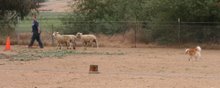
Case in point, Dalla was born in Iceland, and she certainly shows the natural ability to drive, but given that my farm is on flat (mostly) pasture, and that I am working with my dogs in a much smaller fenced in pasture area's (thinking working in pens), working with the sheep in the big barn, and the other main, is working with me as a living moving fence line, as I still have pasture to graze, that is not fenced yet.. always a work in progress.. So to a point I am asking for driving, in the sense of moving the sheep with me to the grazing fields or back to the barn, the issue becomes when the sheep decide to go around me, or take off for the other hundred acres of hay that happens to belong to my neighbour, which is not part of my plan.. now if my dogs really only drove the sheep, we would have a bit of problem here, as I don't have a horse to go round them up, and its just me out there, not a group of peaple, but thankfully the Icelandic is smart, and wanting to work with me, is able to figure out that I want her to "go round" and to bring them back to me.. now that is a typical herding trait, and the Icelandic's do it as a upright(standing up) Barking (giving voice) running breed, which is what the standard calls for..
Same as in the barn, If coming in the front door, you need to go back different sets of stalls and of course the pen that holds all the metal garable cans filled with feed (the cans are to keep the feed dry, clean and mice free), which as you can imagine is a major draw, as the sheep know! that is where the grain is keep, and they want to try and go there.. honestly as the sheep do not feel the need to flock together, in the barn or outside (often willing to split into two or more groups as grazing) I rely on the dogs I have out and are working with to keep them together and to follow my commands, example in the barn, Dalla will push the sheep towards the barn, and I want this, but at the barn, I need to open the door, then back off to let the sheep in, at that point, I want Dalla to stay at the door, one, so the sheep don't go back out, and two so I can get to the end of the barn to open the door to the back barn which is where the sheep go.. so at that point, I can tell Dalla, Ok, push them, and she will make them all come down the barn and into their pen, now I know you are thinking this sounds so simple, and it can be.. but trust me, before I had a trained dog that would listen, or the odd time when I don't have dog with me, and I go to put them away, I have truly spent half an hour going around the barn or fields, trying to get sheep that do not want to in yet into the barn and into their pens..
My favorite was I had all the doors open and pens gates ready and I had been going around and around, the group split into two, which did not help, they were all on my hay fields no issue there, just that I wanted to put them away for the night.. finally I went stopping to house, and I threw open the door and said, Dalla Sheep, Barn.. and I am not kidding, she had them in rounded up, drove and into the barn and into their pen by the time I walked into the barn.. and I just patted her and shut the gate..
So I guess, the question Monika asks is important, if the dogs "drive" in Iceland, and are not trained so much as used with instinst and men on horse back to help, and in other coutries, they have different sheep (different flocking) and different landscape, there for different needs, and the dogs adapt to that, how do we make sure we are breeding and picking the next generation to have the herding instinct that Iceland born dogs have..
The answer is multi faced for sure.. and I am not sure anyone will have a true answer at this point, only time will tell.. I think that keeping the natural herding instincts within the breed is important, but I do think that using the dogs on different sheep, in different landscape, on different animals, (example, used to herd Cattle in Montana, and she swears that her ISD herd like her borders, now is that because the dog was raised with borders?) or the folks around that world that use the dogs to work with their horses, they are clearly "driving " the horse, so that comes quite naturally for sure, but they still do it as an icelandic.. I have an ISD on a horse farm in Alberta, and he does wonderful with them.
I think for me, I hope that by doing a formal puppy temperment test and keeping records on all the Greenstone adult Icelandics and the puppy test results, I will be able to do two things, one figure out what puppies and lines are being born with the most "natural driving" seen and used in Iceland for working their sheep and landscape, and also using the tests to figure out what Puppies and lines are born with the natural instincts to figure out what is required here and now, and therefor will learn what each sheep, horse or cattle needs.
What Monika and I came to, is that once again this breed is smart enought that with the right placement and owners, that ISD's can learn to do what is needed..
Got to love them. Greenstone Ada HI (pointed) working with flocking sheep in Ontario
Barks

Dif The Icelandic Sheepdog Club in Iceland


Hello Folks, I had posted information on the current Calander and that you could contact DIF, but it would appear that its not easy to find DIF, so I I have included a link for you to be able to directly go to the it, you will find a link for the calander third down the page.
Sorry folks that English side of the side is still coming, so its in Icelandic right now, but look for this photo(to the left) and you will see the links for the Calander with it..

Friday, February 09, 2007

UKC CH Pineridge Elska CGC


Hello Folks,
Well, its a fine snowy morning, and I saw that folks were looking for a photo of Ch Pineridge Elska CGC, who had two litters for Aldebaren Kennels in the early 2000's. She was bred once with a Denmark Imported Male (only litter this male had) and once with Klumper from Frelsi Farms. Sadly Elska passed away after these two litters, but her offspring and Grand-offspring have gone on to great things, and there was a public post put out for photos of this lovely lady, and it would appear that I am one of the few that have some.. so here is a very nice head profile of this sweet dog, She was very healthy, had good hips and CERF normals, she was a very! soft female in temperment, she was very easy to train but needed to be worked with in a very soft way.. I have video of Elska in movement, and she had a nice topline, quite good shoulders layback, and while she had good drive, she had med reach, coming and going, she looked good on the front, but showed some toeing in on the rear movement. Lower set tail with a very nice curl to it. Good length of Guard hairs, lots of undercoat, but soft for the breed. She carried her head just a bit low in movement, but as I never got to feel her myself, I am unsure as to why. She was greatly loved by all that meet her and I have always heard that she was one of those Icelandic, that folks meet and wanted to have one just like..
Barks